

If you are searching for a trusted eye specialist in New Delhi or an experienced eye doctor in New Delhi, it helps to first understand which type of specialist your symptoms actually need. Bharti Eye Foundation brings together ophthalmologists trained across cornea and cataract, retina, glaucoma and pediatric ophthalmology, so patients are matched with the right doctor for their specific eye condition rather than seeing a single general practitioner for every problem.
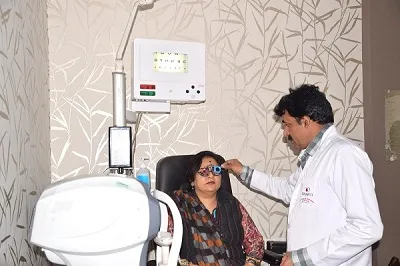
Patients often use the terms "eye doctor" and "eye specialist" interchangeably, but it is useful to know how eye care professionals actually differ:
• Ophthalmologist (Eye Specialist/Eye Doctor): A medical doctor with specialised training in diagnosing and treating eye diseases, prescribing medicines and performing eye surgery, including cataract, retina and cornea procedures.
• Optometrist: A professional trained to examine eyes, test vision and prescribe glasses or contact lenses, but not to perform surgery.
• Optician: A professional who fits and dispenses eyewear based on a prescription provided by an optometrist or ophthalmologist.
For any condition that involves disease, injury or the possibility of surgery - such as cataract, glaucoma, retinal disorders or squint - consulting an ophthalmologist directly is recommended.
Bharti Eye Foundation's clinical team includes ophthalmologists trained across the following sub-specialities:
• Dr. Sudhank Bharti - Founder Director; trained in Cornea, Cataract and Refractive Surgery in England.
• Dr. Dharitri Samantaray - Cornea, Cataract and Refractive Surgery, associated with the Bharti Eye Group for over 17 years, performing eye surgeries, diagnostic investigations, lasers and refractive procedures.
• Dr. Bhupesh Singh - Cornea, Cataract and Refractive Surgery, with a specific focus on keratoconus, corneal opacities, non-healing corneal infections, cornea transplant and LASIK.
• Dr. Bhuvan Chanana and Dr. Neha Bharti - Vitreo-Retina, ROP (Retinopathy of Prematurity) and Uvea specialists managing diabetic retinopathy, vascular occlusions and retinal detachment.
• Dr. Saurabh Varshney - Glaucoma specialist for the diagnosis and long-term management of raised eye pressure.
• Dr. Archana Mahajan - Pediatric Ophthalmology, Squint and Neuro-Ophthalmology, managing children's refractive errors, amblyopia and eye alignment disorders.
You can view full doctor profiles and select a specialist directly on the Find Eye Specialist page.
Many people delay an eye check-up until symptoms become severe. It is advisable to consult an eye specialist if you experience:
• Blurred, dim or reduced vision, at distance or near.
• Halos or glare around lights, particularly at night.
• Sudden flashes of light or an increase in floaters.
• Redness, persistent irritation, or eye pain.
• Double vision or difficulty judging distance.
• A visible squint, or a child frequently tilting their head to see.
• A diagnosis of diabetes, hypertension, or a family history of glaucoma or retinal disease.

Eye specialists at Bharti Eye Foundation regularly evaluate and treat: cataract, refractive errors such as myopia, hypermetropia and astigmatism, corneal conditions including keratoconus, glaucoma, retinal disorders such as diabetic retinopathy and retinal detachment, squint and pediatric eye conditions, dry eye and general vision problems requiring corrective lenses or LASIK.
A typical consultation includes a review of your medical history and symptoms, a vision test, and an examination of the front and back of the eye using specialised instruments. Depending on findings, the specialist may recommend additional diagnostic tests, such as imaging of the retina or measurement of eye pressure. At the end of the consultation, the doctor explains the diagnosis and discusses the treatment options available, whether that involves medication, corrective lenses, or a surgical procedure.
When selecting an eye doctor in New Delhi, consider the following:
• Sub-speciality match: Choose a doctor whose area of training matches your condition - for example, a retina specialist for diabetic eye disease, not a general ophthalmologist.
• Hospital accreditation: A NABH-accredited facility, such as Bharti Eye Foundation, follows documented protocols for patient safety.
• Access to technology: Confirm that the hospital has the diagnostic and surgical equipment relevant to your condition.
• Clear communication: A good specialist explains your diagnosis, treatment options and expected outcomes in a way you understand before recommending a procedure.
Whether you need a routine eye check-up, management of an existing eye condition, or a surgical opinion, the team at Bharti Eye Foundation is available for consultation at East Patel Nagar, New Delhi. You can select a specialist based on your condition or contact the hospital to book an appointment.
Depending on your symptoms, an eye specialist in New Delhi may recommend one or more of the following tests as part of a thorough evaluation:
• Visual acuity test: Measures how clearly you see at a distance and up close.
• Refraction test: Determines your exact glasses or contact lens prescription.
• Tonometry: Measures the pressure inside the eye, used to screen for glaucoma.
• Fundus examination: Allows the specialist to examine the retina and optic nerve at the back of the eye.
• Optical Coherence Tomography (OCT): Provides detailed cross-sectional imaging of the retina, useful in diagnosing and monitoring retinal and glaucoma-related conditions.
• Corneal topography: Maps the surface curvature of the cornea, relevant for conditions like keratoconus and before refractive surgery.
Not every patient needs every test - the specialist selects the relevant ones based on your symptoms and initial examination findings.
Many patients are unsure whether a symptom warrants a specialist visit or will resolve on its own. As a general guide: mild, short-lived redness or dryness after screen use is often not urgent, while symptoms that persist for more than a few days, worsen suddenly, or are accompanied by pain or vision changes should be evaluated by an eye specialist promptly. Sudden vision loss, a curtain-like shadow in your field of vision, or a sudden increase in floaters and flashes should always be treated as urgent and assessed without delay, since these can be early signs of retinal detachment or other serious conditions.
You may also find these pages useful: Best Eye Hospital in Delhi, Best Eye Doctor in Delhi NCR, and LASIK Eye Surgery in New Delhi.
| Week-Days: | 9am - 6pm |
| Sunday: | CLOSED |
Copyright © 2022 · All Rights Reserved Bharti Eye Foundation