

LASIK eye surgery is one of the most widely performed laser vision correction procedures worldwide, used to reduce or remove dependence on glasses and contact lenses. If you are researching LASIK treatment in New Delhi or looking for a LASIK eye surgery hospital in New Delhi, this page explains how the procedure works, who is a suitable candidate, what to expect on the day of surgery, and what to look for in a LASIK hospital in Delhi. Bharti Eye Foundation, a NABH-accredited eye hospital, offers LASIK evaluation and treatment under the care of surgeons trained in refractive surgery.

LASIK stands for Laser-Assisted In Situ Keratomileusis. It is a refractive surgery that uses a laser to reshape the cornea - the clear, dome-shaped front surface of the eye - so that light entering the eye focuses correctly on the retina. LASIK is commonly used to correct:
• Myopia (nearsightedness): difficulty seeing distant objects clearly.
• Hypermetropia (farsightedness): difficulty seeing nearby objects clearly.
• Astigmatism: blurred or distorted vision caused by an irregularly shaped cornea.
The procedure involves creating a thin flap on the outer corneal layer, applying laser energy to reshape the underlying corneal tissue based on the patient's specific refractive error, and then repositioning the flap, which adheres naturally without stitches.
Not every patient with a refractive error is automatically suitable for LASIK. During your consultation, the ophthalmologist assesses several factors before confirming eligibility, including:
• Age and stability of prescription: LASIK is generally considered once the spectacle power has been stable for a period, typically in adulthood.
• Corneal thickness and shape: Sufficient, evenly shaped corneal tissue is required for safe laser reshaping.
• Overall eye health: Conditions such as keratoconus, severe dry eye, or active eye infection may make a patient unsuitable for LASIK, in which case the surgeon may discuss alternative options.
• General health: Certain autoimmune or connective tissue conditions may affect healing and candidacy.
A thorough pre-LASIK screening is the only reliable way to confirm suitability - this should never be skipped, regardless of how routine the procedure may seem.
Before scheduling LASIK, patients typically undergo a comprehensive eye evaluation that includes a detailed refraction test to measure the exact spectacle power, corneal topography to map the shape of the cornea, pachymetry to measure corneal thickness, pupil size measurement, and a tear film assessment to check for dry eye. Patients who wear contact lenses are usually asked to discontinue use for a period before this evaluation, as lenses can temporarily alter corneal shape.
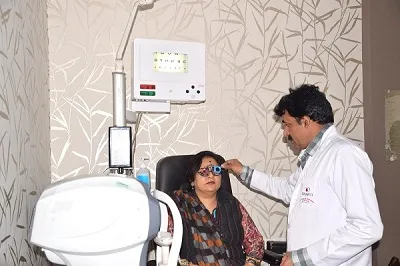
Before the procedure: Numbing eye drops are applied so the patient does not feel pain during surgery. A lid speculum is used to keep the eye open comfortably throughout.
During the procedure: A thin corneal flap is created, the laser reshapes the corneal tissue underneath based on your specific prescription, and the flap is then repositioned. The laser treatment itself is quick, typically taking only a few minutes per eye.
After the procedure: Patients are usually able to go home the same day. Mild irritation, watering, light sensitivity or a gritty sensation is common in the first day or two. The surgeon will prescribe eye drops and provide clear instructions on activity restrictions and the follow-up schedule.
Patients researching refractive surgery in New Delhi often come across both LASIK and SMILE. LASIK involves creating and repositioning a corneal flap, while SMILE eye surgery is a newer, flapless technique performed through a much smaller incision. Neither procedure is universally "better" - the right choice depends on your corneal thickness, degree of refractive error, lifestyle and the surgeon's assessment during your evaluation. This decision should always be made after a detailed one-to-one consultation rather than a general online comparison.
Many patients experience noticeably improved vision within a day of the procedure, though full visual stabilisation can take a few weeks. Common post-operative guidance includes avoiding rubbing the eyes, using prescribed lubricating drops, protecting the eyes from dust and bright light, and avoiding swimming or strenuous activity for a period specified by the surgeon. Regular follow-up visits allow the ophthalmologist to monitor healing and confirm the final visual outcome.
When comparing LASIK hospitals in Delhi, patients should look beyond advertised claims and consider:
• Accreditation: A NABH-accredited hospital, such as Bharti Eye Foundation, follows documented safety and quality protocols.
• Surgeon expertise: Confirm the treating surgeon's specific training and experience in refractive and LASIK surgery - for example, Dr. Bhupesh Singh at Bharti Eye Foundation has extensive experience in cornea, cataract and LASIK procedures.
• Thorough screening, not blanket approval: A trustworthy hospital will tell you honestly if you are not a suitable LASIK candidate, rather than approving every patient who asks for it.
• Clear cost and process communication: Costs vary based on the technology used and individual eye parameters; a good hospital explains this clearly during your consultation rather than quoting a blanket price before an examination.
If you are considering LASIK eye surgery in New Delhi, the first step is a detailed eye evaluation to confirm whether you are a suitable candidate. You can also read more about our broader refractive surgery services or contact Bharti Eye Foundation to book a LASIK consultation with our refractive surgery team.
A number of misconceptions circulate about LASIK, and it helps to separate them from fact:
• "LASIK is suitable for everyone": This is incorrect - suitability depends on corneal thickness, shape, stability of prescription and overall eye health, confirmed only through a proper screening.
• "You can never wear glasses again after LASIK": LASIK treats your existing refractive error, but age-related changes such as presbyopia can still occur later in life and may require reading glasses, independent of the LASIK result.
• "LASIK guarantees perfect 6/6 vision": Most patients achieve significantly improved vision, but the exact outcome depends on individual healing and pre-operative eye parameters, which is why realistic expectations should be discussed during consultation.
• "The cheapest LASIK option is the best choice": Cost should never be the only deciding factor; the surgeon's experience, the hospital's accreditation and thoroughness of pre-operative screening matter more for a safe outcome.
Following your surgeon's post-operative instructions closely has a direct bearing on your recovery. General guidance typically includes: use prescribed lubricating and antibiotic eye drops exactly as directed, avoid rubbing your eyes even if they feel itchy, wear any protective eye shield provided, particularly while sleeping in the first few nights, avoid swimming, dusty environments and eye makeup for the period advised by your surgeon, and attend every scheduled follow-up visit so your surgeon can confirm your eyes are healing as expected. If you notice worsening pain, sudden vision changes or unusual discharge at any point during recovery, contact your surgeon promptly rather than waiting for your next scheduled visit.
You may also find these pages useful: Best Eye Hospital in Delhi, Eye Specialist & Eye Doctor in New Delhi, and Best Eye Doctor in Delhi NCR.
| Week-Days: | 9am - 6pm |
| Sunday: | CLOSED |
Copyright © 2022 · All Rights Reserved Bharti Eye Foundation