

CLEAR stands for Corneal Lenticule Extraction for Advanced Refractive correction - a newer, flapless refractive surgery for myopia and astigmatism, performed using the Ziemer Femto LDV Z8 femtosecond laser. Bharti Eye Foundation, a NABH-accredited eye hospital in East Patel Nagar, New Delhi, offers CLEAR as one of its refractive surgery options. This page explains what CLEAR is, how the procedure works, how it compares to LASIK and SMILE, and what patients in Delhi can expect.
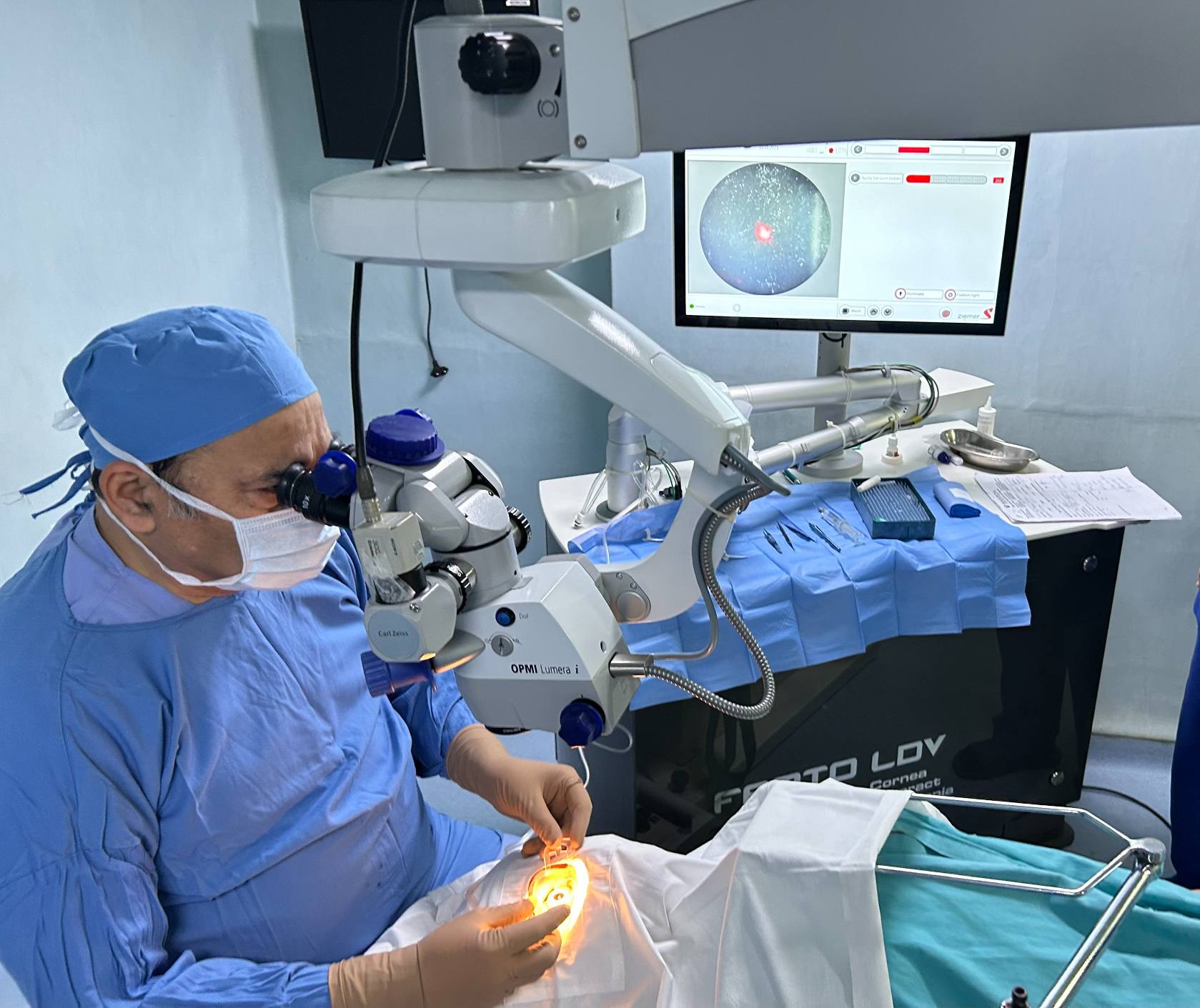
CLEAR is a corneal lenticule extraction technique - a category of flapless refractive surgery that also includes SMILE. In CLEAR, the femtosecond laser creates two thin layers within the stromal layer of the cornea, forming a disc-shaped piece of tissue called a lenticule. The surgeon then gently removes this lenticule through a small incision. Removing the lenticule permanently reshapes the cornea, which corrects how light focuses on the retina and improves vision without glasses or contact lenses for most treated patients. Throughout this process, the top layers of the cornea remain intact - no surface flap is cut, unlike in LASIK.
CLEAR is performed exclusively on the Ziemer Femto LDV Z8, a femtosecond laser platform developed by Ziemer Ophthalmic Systems (Switzerland). Unlike some other femtosecond lasers that use higher-energy pulses, the Femto LDV Z8 is built around a low-energy, high-frequency laser concept: it delivers a very high repetition rate of overlapping, low-energy pulses through a compact handpiece positioned very close to the eye. This approach is designed to achieve a smooth, precise corneal cut while minimising the amount of energy - and therefore tissue disruption and inflammatory response - delivered to the eye. The laser also offers surgeons adjustable centration and rotation options during the procedure, which supports precise treatment planning for each patient's eye.
Patients researching refractive surgery in Delhi often come across three related but distinct laser vision correction techniques:
• LASIK: A corneal flap is created first, then an excimer laser reshapes the tissue underneath, and the flap is repositioned.
• SMILE: A flapless lenticule extraction technique performed on the Zeiss VisuMax laser platform, removing a lenticule through a small incision.
• CLEAR: A flapless lenticule extraction technique performed on the Ziemer Femto LDV Z8 platform, using a distinct low-energy laser approach to create and remove the lenticule.
SMILE and CLEAR belong to the same broader family of procedures - both avoid a surface flap - but they use different laser technologies from different manufacturers. Published clinical comparisons between CLEAR and SMILE have generally reported comparable safety and visual outcomes for the correction of myopia and myopic astigmatism. The right technique for you depends on your specific corneal measurements, refractive error and eye health, which your surgeon evaluates individually.

Based on how the CLEAR technique is designed and performed, the procedure is associated with the following characteristics:
• No corneal flap: The top layers of the cornea remain intact throughout the procedure.
• No bandage or contact lens typically required after the procedure.
• Lower risk profile for dry eye compared to some flap-based refractive procedures.
• Minimal tissue damage and minimal side effects, owing to the low-energy laser concept.
• Short recovery time, with visual recovery reported within 24 hours for many patients.
• No risk of flap dislocation, since no flap is created.
• Can be an option for some patients who are not suitable for LASIK, including certain patients with dry eye tendencies, subject to individual evaluation.
• Return to routine work activity in around three days for many patients, depending on individual healing.
CLEAR is generally considered for patients with myopia (nearsightedness) and astigmatism. As with any refractive surgery, candidacy depends on a detailed pre-operative evaluation, including corneal thickness (pachymetry), corneal shape (topography), pupil size, tear film assessment and overall eye health. Some patients who are not ideal candidates for LASIK - for example, due to certain dry eye tendencies or corneal characteristics - may still be evaluated for CLEAR or SMILE, but this determination can only be made after an individual, in-person assessment by your ophthalmologist.
Bharti Eye Foundation, a NABH-accredited eye hospital operating from East Patel Nagar, New Delhi since 1985, offers CLEAR using the Ziemer Femto LDV Z8 femtosecond laser as part of its refractive surgery services, alongside LASIK and SMILE eye surgery. If you are exploring glasses removal options, read more about the patient experience on our CLEAR Spectacles Removal Surgery page, or learn what to look for in a surgeon on our Best CLEAR Procedure Surgeon in Delhi page. To find out if you are a candidate, contact the hospital to book a refractive surgery evaluation.
Before CLEAR surgery is recommended, patients undergo a detailed refractive surgery workup. This typically includes a precise refraction test to measure your exact spectacle power, corneal topography to map the curvature of the cornea, pachymetry to measure corneal thickness, pupil size measurement, tear film assessment to screen for dry eye, and a dilated examination of the retina and optic nerve to rule out other eye conditions. Contact lens wearers are usually advised to stop wearing lenses for a period before this evaluation, since lenses can temporarily alter the natural shape of the cornea and affect measurement accuracy. Only after reviewing all of these results does the surgeon confirm whether CLEAR, or an alternative procedure, is the right fit.
Post-operative care following CLEAR typically includes prescribed lubricating and antibiotic eye drops, avoiding rubbing the eyes, protecting the eyes from dust and bright light in the initial days, and avoiding swimming or strenuous activity for the period advised by the surgeon. Since CLEAR does not involve a surface flap, some of the flap-specific precautions required after LASIK - such as extra caution against flap dislodgement - do not apply in the same way. Regardless, attending every scheduled follow-up visit is important so your surgeon can confirm that your eyes are healing as expected and address any concerns promptly.
You may also find these pages useful: CLEAR Spectacles Removal Surgery in Delhi, Best CLEAR Procedure Surgeon in Delhi, and LASIK Eye Surgery in New Delhi.
| Week-Days: | 9am - 6pm |
| Sunday: | CLOSED |
Copyright © 2022 · All Rights Reserved Bharti Eye Foundation