

There is no government body or independent authority in India that officially ranks eye hospitals as "the best." Any hospital that makes this claim is describing its own reputation, not citing an official award. Because of this, the more useful question for a patient is not "who says they are the best?" but "which hospital's credentials can I actually verify?" This page sets out the documented, independently checkable facts about Bharti Eye Foundation, New Delhi - its founding history, accreditation, clinical team, services and academic record - alongside a practical checklist you can use to evaluate any eye hospital in India, not just this one.

Since no official ranking exists, evaluating a hospital comes down to checking specific, verifiable criteria rather than trusting a website's own claims. The factors that matter most are:
• Accreditation: A recognised certification such as NABH means the hospital has been independently assessed against defined standards - not simply self-declared.
• The founding surgeon's documented clinical history: Where they trained, when they started practising specific procedures, and whether this is corroborated on independent medical directories, not only the hospital's own site.
• Academic and professional recognition: Papers presented at recognised ophthalmology forums, textbook contributions, and awards from named medical bodies - all of which can, in principle, be checked.
• Range of sub-speciality services: Whether cornea, cataract, retina, glaucoma and pediatric ophthalmology are genuinely available under one roof, so patients aren't shuttled between multiple facilities.
• Transparency about screening and candidacy: Whether the hospital is willing to tell a patient they are not suitable for a particular procedure, rather than approving everyone who asks.
The remainder of this page walks through Bharti Eye Foundation against each of these points, and closes with a general checklist you can apply to compare any hospital.
Bharti Eye Foundation was founded in 1985 by Dr. Sudhank Bharti. He completed his MBBS with Honours and his postgraduate MS in Ophthalmology from S.N. Medical College, Agra, in 1981, and was awarded the Best House Officer Award during his residency. He subsequently travelled to the United Kingdom, where he worked as a clinical assistant under Dr. J.J. Kanski and later Dr. R. Hitchings - both established names in ophthalmology - before starting private practice in 1984 and founding Bharti Eye Foundation in New Delhi the following year. The hospital is accredited by the National Accreditation Board for Hospitals and Healthcare Providers (NABH), a constituent board of the Quality Council of India.
One of the most significant, independently verifiable facts about Dr. Bharti's career is his early and pioneering role in refractive surgery in India:
• 1987: Began performing refractive surgery using Radial Keratotomy, an early technique for correcting myopia.
• 1994: Introduced Automated Keratomileusis, a precursor technique to modern LASIK.
• 1995: Among the first surgeons in India to perform LASIK surgery - a milestone independently documented on multiple third-party medical directories, not only the hospital's own website.
• Ongoing: Participated in a multicentre study on LASIK conducted by Loma Linda University, California, USA, and has run a certified LASIK training programme that has trained surgeons from the Asia-Pacific region.
This kind of documented, dated clinical history - rather than a vague claim of "decades of excellence" - is what allows a patient to actually verify a surgeon's experience instead of taking it on faith.

Beyond clinical practice, Dr. Bharti's academic record includes over 50 original papers presented at major national and international ophthalmology forums, including the All India Ophthalmological Society (AIOS), the American Society of Cataract and Refractive Surgery (ASCRS), the European Society of Cataract and Refractive Surgeons (ESCRS), the American Academy of Ophthalmology (AAO), the Asia-Pacific Academy of Ophthalmology (APAO), the Korean Society of Cataract and Refractive Surgery, and the Delhi Ophthalmological Society (DOS). He has contributed 5 chapters to ophthalmic textbooks, has conducted instruction courses at ASCRS, ESCRS and AIOS, and served as an international investigator for LASIK with Nidek, Japan. His documented awards include the Dr. AN Pandeya Oration Award from the Bihar Ophthalmological Society (2006) and the Dr. T. Agarwal Gold Medal from IIRSI (2004). These are specific, named awards from identifiable medical bodies, which patients or referring doctors can independently look into rather than accept at face value.
NABH accreditation is not a marketing badge - it reflects an independent assessment against a defined set of national standards covering areas such as infection control practices, operation theatre protocols, documentation of informed patient consent, medication management, staff training and continuing education, and processes for reporting and reviewing patient safety incidents. For a surgical speciality like ophthalmology, where procedures such as cataract surgery, LASIK and cornea transplant are performed routinely, these standards have a direct bearing on how consistently safe outcomes are. When comparing hospitals, it is reasonable to ask directly whether NABH accreditation is current, and this status can also be verified independently through NABH's own official channels.
Bharti Eye Foundation offers the following services, so that most patients do not need to be referred to a separate facility mid-treatment:
• Cataract Surgery & Phacoemulsification: Bladeless, modern cataract removal with intraocular lens implantation.
• LASIK: Flap-based laser vision correction for myopia, hypermetropia and astigmatism, using the Ziemer Femto LDV Z8 femtosecond laser for bladeless flap creation.
• CLEAR: A flapless refractive procedure performed on the same Ziemer Femto LDV Z8 platform for eligible patients with myopia and astigmatism.
• Refractive Surgery: Broader vision correction services for patients wanting to reduce dependence on glasses.
• Retina Surgery: Management of diabetic retinopathy, retinal detachment and vascular disorders of the retina.
• Glaucoma Treatment: Diagnosis and long-term management of raised eye pressure.
• Cornea Transplant: Surgical treatment for corneal opacities, keratoconus and non-healing corneal infections.
• Squint Treatment & Pediatric Ophthalmology: Care for children's vision, amblyopia and eye alignment.
• Contact Lens Services & Oculoplasty and Aesthetic treatment.
If a specific procedure is not currently offered at the hospital, patients should always confirm directly with the hospital before assuming availability, rather than relying solely on general online listings.
Alongside Dr. Sudhank Bharti, the hospital's clinical team includes ophthalmologists trained in specific sub-specialities, rather than a single general ophthalmologist handling every condition:
• Dr. Dharitri Samantaray - Cornea, Cataract and Refractive Surgery; associated with the Bharti Eye Group for over 17 years, performing eye surgeries, diagnostic investigations, lasers and refractive procedures.
• Dr. Bhupesh Singh - Cornea, Cataract and Refractive Surgery, with specific focus on keratoconus, corneal opacities and non-healing corneal infections; extensive experience in cornea transplant, cataract surgery and LASIK.
• Dr. Bhuvan Chanana and Dr. Neha Bharti - Vitreo-Retina, ROP (Retinopathy of Prematurity) and Uvea, managing diabetic retinopathy, vascular occlusions and retinal detachment.
• Dr. Saurabh Varshney - Glaucoma diagnosis and long-term management.
• Dr. Archana Mahajan - Pediatric Ophthalmology, Squint and Neuro-Ophthalmology.
Full profiles are listed on the Find Eye Specialist page, where patients can choose a doctor based on their specific condition.
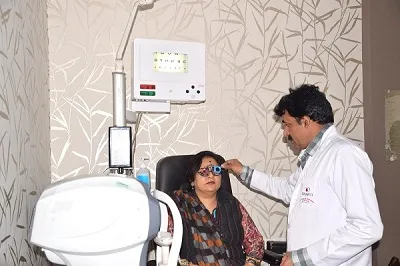
For refractive procedures, Bharti Eye Foundation uses the Ziemer Femto LDV Z8 femtosecond laser - a low-energy, high-frequency laser platform used both for bladeless flap creation in LASIK and for the flapless CLEAR procedure. For diagnostic evaluation, the hospital uses corneal topography to map corneal shape, pachymetry to measure corneal thickness, and retinal imaging to evaluate the back of the eye. If you are considering a specific procedure, it is always worth confirming directly with the hospital which exact equipment will be used for your treatment, rather than assuming based on general descriptions - technology and available procedures can change over time, and confirming current capability protects you from planning around outdated information.
1. Booking a consultation: Patients can book through the online appointment form, by phone, or via WhatsApp, and may request a specific specialist based on their condition.
2. Initial consultation: A detailed history is taken, followed by a vision test and examination of the front and back of the eye.
3. Diagnostic workup: Depending on the suspected condition, additional tests may be recommended - such as corneal topography and pachymetry before refractive surgery, or retinal imaging for suspected retinal disease.
4. Diagnosis and treatment discussion: The specialist explains the diagnosis, available treatment options, and, where surgery is being considered, expected outcomes and possible risks.
5. Informed consent: Before any surgical procedure, patients are asked to provide documented informed consent, part of the NABH-mandated patient safety process.
6. Day of surgery: For surgical procedures, patients are guided through pre-operative preparation, the procedure itself, and immediate post-operative instructions.
7. Follow-up care: A follow-up schedule is provided so the treating doctor can monitor recovery and confirm the final outcome.
Understanding this sequence in advance can help patients - particularly those travelling from outside Delhi - plan their visit and any necessary follow-up trips more effectively.
Whether or not you choose Bharti Eye Foundation, the following checklist applies to evaluating any eye hospital in India:
☐ Is the hospital accredited? Ask specifically about NABH or an equivalent recognised accreditation, and confirm it is current.
☐ Does the treating doctor's training match your condition? A cornea specialist for corneal disease, a retina specialist for diabetic eye disease, a glaucoma specialist for raised eye pressure, and so on.
☐ What diagnostic tests will be done before a diagnosis or treatment plan is confirmed? A hospital that skips a thorough workup is a warning sign.
☐ What equipment will actually be used for your specific procedure? Ask by name rather than accepting general marketing language.
☐ Will the hospital tell you if you are not a suitable candidate for a procedure you are interested in, rather than approving every patient who asks?
☐ Can you verify the doctor's qualifications and experience independently - for example, through the Delhi Medical Council or National Medical Commission registers, or third-party medical directories - rather than relying on the hospital's own website alone?
☐ Is there a clear post-operative follow-up plan, including who to contact if you have concerns after your procedure?
For patients researching where to seek treatment, it helps to understand the basics of the conditions being treated:
• Cataract: Clouding of the eye's natural lens, most common with advancing age, causing blurred or dim vision. Treated surgically through phacoemulsification with intraocular lens implantation - there is no medication that reverses a cataract.
• Refractive errors: Myopia (nearsightedness), hypermetropia (farsightedness) and astigmatism occur when the shape of the eye or cornea does not focus light correctly on the retina. These can be corrected with glasses, contact lenses, or refractive surgery such as LASIK or CLEAR for suitable candidates.
• Glaucoma: A group of conditions that damage the optic nerve, often, though not always, associated with raised pressure inside the eye. Glaucoma is a leading cause of irreversible vision loss globally, which is why regular screening matters, particularly for those with a family history.
• Retinal disease: Includes diabetic retinopathy, retinal detachment and age-related changes to the retina, all of which can threaten vision if not identified and treated promptly.
• Squint (strabismus): Misalignment of the eyes, most commonly identified in childhood, which can affect depth perception and, if untreated, lead to amblyopia (lazy eye).
This is general educational information and is not a substitute for an individual diagnosis by a qualified ophthalmologist.
Certain symptoms warrant a prompt eye examination rather than waiting: gradually blurred or dim vision, halos around lights, difficulty seeing at night, double vision, a diagnosis of diabetes or a family history of glaucoma. Some symptoms require urgent same-day attention rather than a routine appointment: sudden loss of vision, a sudden increase in floaters or flashes of light, a curtain-like shadow across your field of vision, severe eye pain, or an eye injury. If you experience any of these urgent symptoms, contact an eye hospital directly by phone rather than waiting for the next available routine slot.
Beyond hospital-based clinical practice, Dr. Bharti runs the Keshav Sagar Eye Research Foundation, a charitable institution that provides free eye care to underprivileged patients, and has been associated with Rotary's free cataract surgery initiative, "Gift of Sight," for which he received the Rotary Outstanding Services Award during Rotary's centennial year. More information is available on our Charity page.
Bharti Eye Foundation states that it has treated patients travelling from across India for specialised procedures such as LASIK, cataract surgery and cornea transplant. This is a claim made by the hospital about itself, and we present it here as such - it is not an independently audited statistic, and we encourage readers to treat it accordingly. What can be independently verified, however, is the underlying reason patients might choose to travel: a four-decade operating history, NABH accreditation, and a founding surgeon with a documented pioneering role in Indian refractive surgery - factors that plausibly explain, without needing to be taken purely on faith, why some patients would choose to travel rather than opt for a closer but unaccredited facility.
Many hospital websites use superlative language - "best," "top," "number one" - without pointing to anything a patient can check. Throughout this page, we have tried to separate two categories of information: documented facts, such as founding year, accreditation status, a surgeon's medical qualifications and dated clinical milestones, which can be independently corroborated; and self-reported claims, such as total patient counts, which a hospital states about itself but which are not independently audited. We encourage every patient - whether considering this hospital or any other in India - to apply the same distinction when comparing options.
Bharti Eye Foundation operates from 1/3 East Patel Nagar, New Delhi - 110008, a centrally located and well-connected part of Delhi. The Bharti Eye Group also runs a facility at Greater Kailash, New Delhi. The hospital is open Monday to Saturday, 9 AM to 6 PM, and is closed on Sundays. Patients travelling from other states are encouraged to book their consultation in advance and factor in time for any diagnostic tests and, where relevant, follow-up visits after a procedure.
Bharti Eye Foundation is empanelled with several health schemes and organisations. Patients can check the hospital's Empanelment page or contact the hospital directly to confirm coverage under their specific insurer or scheme before their visit. To discuss your specific eye condition or plan a visit from outside Delhi, contact Bharti Eye Foundation directly, or explore related pages: Best Eye Hospital in Delhi, Best Eye Doctor in Delhi NCR, and Eye Specialist & Eye Doctor in New Delhi.
For any significant diagnosis or recommended surgery - cataract, retinal surgery, cornea transplant, glaucoma surgery or refractive surgery - seeking a second opinion is a reasonable and common step, not a sign of distrust. Bringing your existing reports, scans and the treatment plan already suggested to a second ophthalmologist allows them to review your case efficiently and either confirm the diagnosis or offer an alternative perspective. Patients considering treatment at Bharti Eye Foundation, or at any hospital in India, are encouraged to bring prior records to their consultation so the treating doctor has a complete picture before finalising a recommendation. Similarly, medical qualifications of any doctor practising in India can be checked against the state medical council register or the National Medical Commission's records, and hospital accreditation status can be verified through NABH's own official listings - none of this requires taking a hospital's word for it.
If you are planning to visit Bharti Eye Foundation, or any eye hospital, a little preparation makes the visit more productive:
• Bring existing records: Previous prescriptions, eye reports, scans, and a summary of any earlier diagnosis or treatment.
• List your medications: Include all current medications and known allergies, particularly if surgery is being considered.
• Note relevant health conditions: Diabetes, hypertension, thyroid disorders and autoimmune conditions can all affect eye health and treatment planning.
• Stop contact lens use beforehand if advised: For refractive surgery evaluations, patients are often asked to discontinue lenses for a period before assessment, since lenses can temporarily change the shape of the cornea.
• Write down your symptoms and questions in advance: This helps ensure nothing is missed during a time-limited consultation, especially if you have travelled from outside Delhi.
• Plan for follow-up: If a procedure is recommended, ask upfront how many follow-up visits are typically required and over what period, so you can plan travel and time off work accordingly.
Patients researching eye hospitals in India often come across technical terms without a clear explanation. A few worth knowing:
• NABH: National Accreditation Board for Hospitals and Healthcare Providers - an Indian body that independently assesses hospitals on patient safety and quality-of-care standards.
• Ophthalmologist: A medical doctor with specialised training to diagnose and treat eye disease, prescribe medication and perform eye surgery, as distinct from an optometrist, who examines eyes and prescribes corrective lenses but does not perform surgery.
• Phacoemulsification: The standard modern technique for cataract removal, using ultrasound energy to break up the cloudy lens before it is removed and replaced with an artificial intraocular lens.
• Femtosecond laser: A precision laser technology used in some refractive and cataract procedures to make highly accurate corneal incisions.
• Pachymetry: A diagnostic test that measures corneal thickness, used before refractive surgery to help confirm candidacy.
• Vitreo-retina: The ophthalmology sub-speciality dealing with the vitreous gel and retina at the back of the eye, relevant to conditions like diabetic retinopathy and retinal detachment.
Understanding these terms can help you ask more specific, informed questions during any consultation, wherever you choose to be treated.
In preparing this page, we deliberately avoided vague superlatives that cannot be checked. Every specific claim about Dr. Bharti's clinical milestones, qualifications and awards is corroborated across more than one source, including independent medical directories separate from this website. Where a claim originates only from the hospital's own statements - such as the extent of patients treated from across India - we have said so explicitly rather than presenting it as an independently confirmed fact. We believe this approach is more useful to a patient making a genuinely important healthcare decision than a page filled with unverifiable claims of being "the best," and we would encourage you to expect - and ask for - the same level of transparency from any hospital you are considering.
| Week-Days: | 9am - 6pm |
| Sunday: | CLOSED |
Copyright © 2022 · All Rights Reserved Bharti Eye Foundation